
India’s journey is characterized by its resilience and capacity for rapid change. While progress in health, sanitation, and infrastructure is evident, speed remains a challenge, especially in environmental reforms, rights protections, and inclusive growth. In this episode of Beyond GDP: The Social Progress Podcast, Michael Green invites Dr. Amit Kapoor, Chairman of the Institute for Competitiveness, to analyze how India has achieved significant social progress and where their opportunities lie. Dr. Amit Kapoor was behind the creation of the Social Progress Index for States and Districts in India, released by the Economic Advisory Council to the Prime Minister.
Beyond domestic issues, India’s role in geopolitics continues to evolve. Kapoor emphasizes that India must work on internal strength and technological innovation to expand its global influence. He points to India's pioneering digital solutions, which are transforming financial inclusion and are being adopted worldwide. Such innovations position India as a developmental leader rather than solely a market.
Kapoor reminds readers that India’s diversity is its strength. Its ability to interconnect different cultures, religions, and languages sustains social cohesion. However, it must also confront systemic issues. On the one hand, the country has made significant improvements in healthcare, sanitation, and infrastructure development. On the other, challenges like malnutrition, poor sanitation, and rising lifestyle-related diseases persist. For instance, despite improvements, malnutrition remains prevalent in certain regions, while type 2 diabetes in the middle class shows the rapid lifestyle changes.
The Global Social Progress Index indicates a slowdown in global social progress since 2021. However, when examining India specifically, the country has seen a modest increase of about 1.5 points since 2024, after a substantial leap of nine points between 2014 and 2020. Dr. Kapoor emphasizes that this slowdown is not unique to India. Countries worldwide, including China, have experienced similar decelerations, often linked to global turmoil, conflicts, and shifts in funding, such as the reduction of USAID programs. Nonetheless, India's overall trajectory remains positive, especially when considering its size and diversity. Between 2014 and 2020, India made remarkable progress, driven by government programs focused on social development, health, and infrastructure. Notably, the Aspirational District Program helped uplift the poorest districts, with half of them now ranking among the top 300 districts on social progress metrics. Despite these advancements, Dr. Kapoor points out that India cannot be viewed as a monolith. Its vast array of states and districts experiencing different realities. Some regions excel, while others lag behind, highlighting the importance of localized approaches.
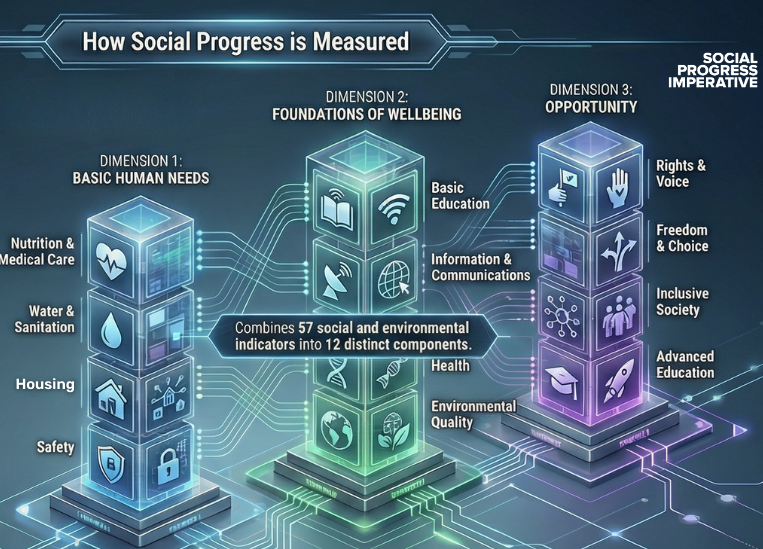
India’s story is one of balancing the old and the new, embracing its cultural diversity while striving for social equity. Its progress, as measured by tools such as the India Social Progress Index, demonstrates both remarkable achievements and areas that need urgent attention. As the country builds its future, understanding these complexities helps stakeholders, locally and globally, support sustainable and inclusive growth.
India’s journey is characterized by its resilience and capacity for rapid change. While progress in health, sanitation, and infrastructure is evident, speed remains a challenge, especially in environmental reforms, rights protections, and inclusive growth. In this episode of Beyond GDP: The Social Progress Podcast, Michael Green invites Dr. Amit Kapoor, Chairman of the Institute for Competitiveness, to analyze how India has achieved significant social progress and where their opportunities lie. Dr. Amit Kapoor was behind the creation of the Social Progress Index for States and Districts in India, released by the Economic Advisory Council to the Prime Minister.
Beyond domestic issues, India’s role in geopolitics continues to evolve. Kapoor emphasizes that India must work on internal strength and technological innovation to expand its global influence. He points to India's pioneering digital solutions, which are transforming financial inclusion and are being adopted worldwide. Such innovations position India as a developmental leader rather than solely a market.
Kapoor reminds readers that India’s diversity is its strength. Its ability to interconnect different cultures, religions, and languages sustains social cohesion. However, it must also confront systemic issues. On the one hand, the country has made significant improvements in healthcare, sanitation, and infrastructure development. On the other, challenges like malnutrition, poor sanitation, and rising lifestyle-related diseases persist. For instance, despite improvements, malnutrition remains prevalent in certain regions, while type 2 diabetes in the middle class shows the rapid lifestyle changes.
The Global Social Progress Index indicates a slowdown in global social progress since 2021. However, when examining India specifically, the country has seen a modest increase of about 1.5 points since 2024, after a substantial leap of nine points between 2014 and 2020. Dr. Kapoor emphasizes that this slowdown is not unique to India. Countries worldwide, including China, have experienced similar decelerations, often linked to global turmoil, conflicts, and shifts in funding, such as the reduction of USAID programs. Nonetheless, India's overall trajectory remains positive, especially when considering its size and diversity. Between 2014 and 2020, India made remarkable progress, driven by government programs focused on social development, health, and infrastructure. Notably, the Aspirational District Program helped uplift the poorest districts, with half of them now ranking among the top 300 districts on social progress metrics. Despite these advancements, Dr. Kapoor points out that India cannot be viewed as a monolith. Its vast array of states and districts experiencing different realities. Some regions excel, while others lag behind, highlighting the importance of localized approaches.
India’s story is one of balancing the old and the new, embracing its cultural diversity while striving for social equity. Its progress, as measured by tools such as the India Social Progress Index, demonstrates both remarkable achievements and areas that need urgent attention. As the country builds its future, understanding these complexities helps stakeholders, locally and globally, support sustainable and inclusive growth.


.png)

.jpg)

