The Florida Community Progress Index is a data insights tool that shows quality of life at the census tract level in central Florida, revealing the strengths and challenges of neighborhoods across Orange and Osceola counties.
Traditional demographic and economic metrics paint an incomplete picture of how communities really live, hiding a neighborhood’s true opportunities or vulnerabilities. For example, what actually prevents someone from earning a college degree? Is it a lack of higher education options, or do hidden barriers like poor internet access or limited mental health support play a bigger role than we think?
The Florida Community Progress Index (FCPI) was created in partnership with Habitat for Humanity Greater Orlando & Osceola County. As a unique data insights platform, the FCPI enables governments, nonprofits, and community leaders to build evidence-based strategic plans, optimize resource allocation, and maximize the impact of local interventions. Powered by the global Social Progress Index framework, the FCPI translates complex social and environmental data into actionable insights for lasting community change.
Traditional demographic and economic metrics paint an incomplete picture of how communities really live, hiding a neighborhood’s true opportunities or vulnerabilities. For example, what actually prevents someone from earning a college degree? Is it a lack of higher education options, or do hidden barriers like poor internet access or limited mental health support play a bigger role than we think?
The Florida Community Progress Index (FCPI) was created in partnership with Habitat for Humanity Greater Orlando & Osceola County. As a unique data insights platform, the FCPI enables governments, nonprofits, and community leaders to build evidence-based strategic plans, optimize resource allocation, and maximize the impact of local interventions. Powered by the global Social Progress Index framework, the FCPI translates complex social and environmental data into actionable insights for lasting community change.

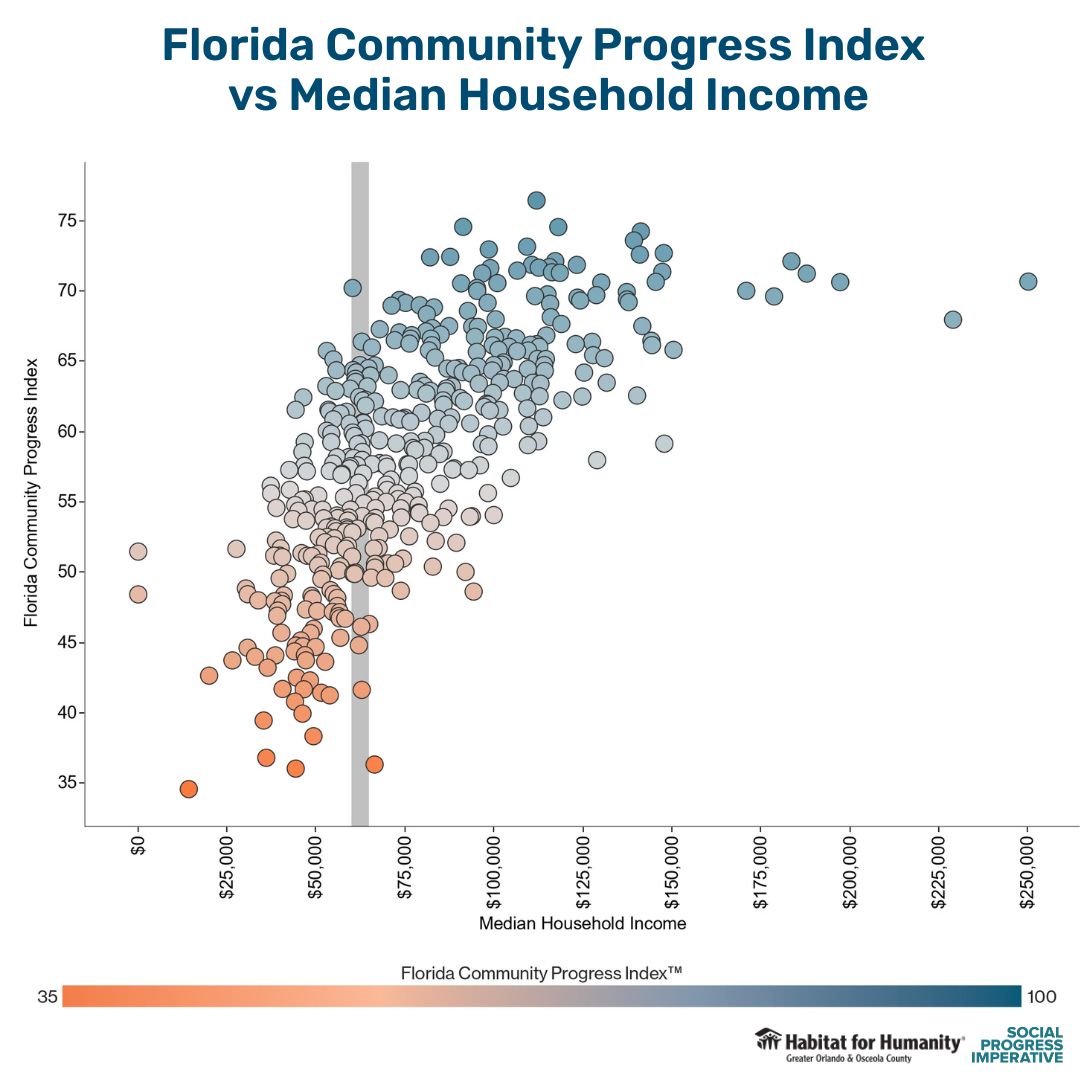
The Florida Community Progress Index is free from strict economic variables. For example, progress is not measured using income, business starts, or employment rates. This provides a baseline to measure progress that is separate from economic growth.
While there is generally a positive relationship between progress and income, there are neighborhoods with vastly different outcomes despite having the same income levels. See the gray band that captures census tracts with incomes between $60,000 and $65,000 annually. The diversity of FCPI values in this income bracket is large, ranging from neighborhood values well below average at 36 to well above average at 70 (out of a score of 100). Understanding these dynamics at a deeper level, including the role that housing plays in increasing neighborhood progress, is part of next steps for the FCPI.
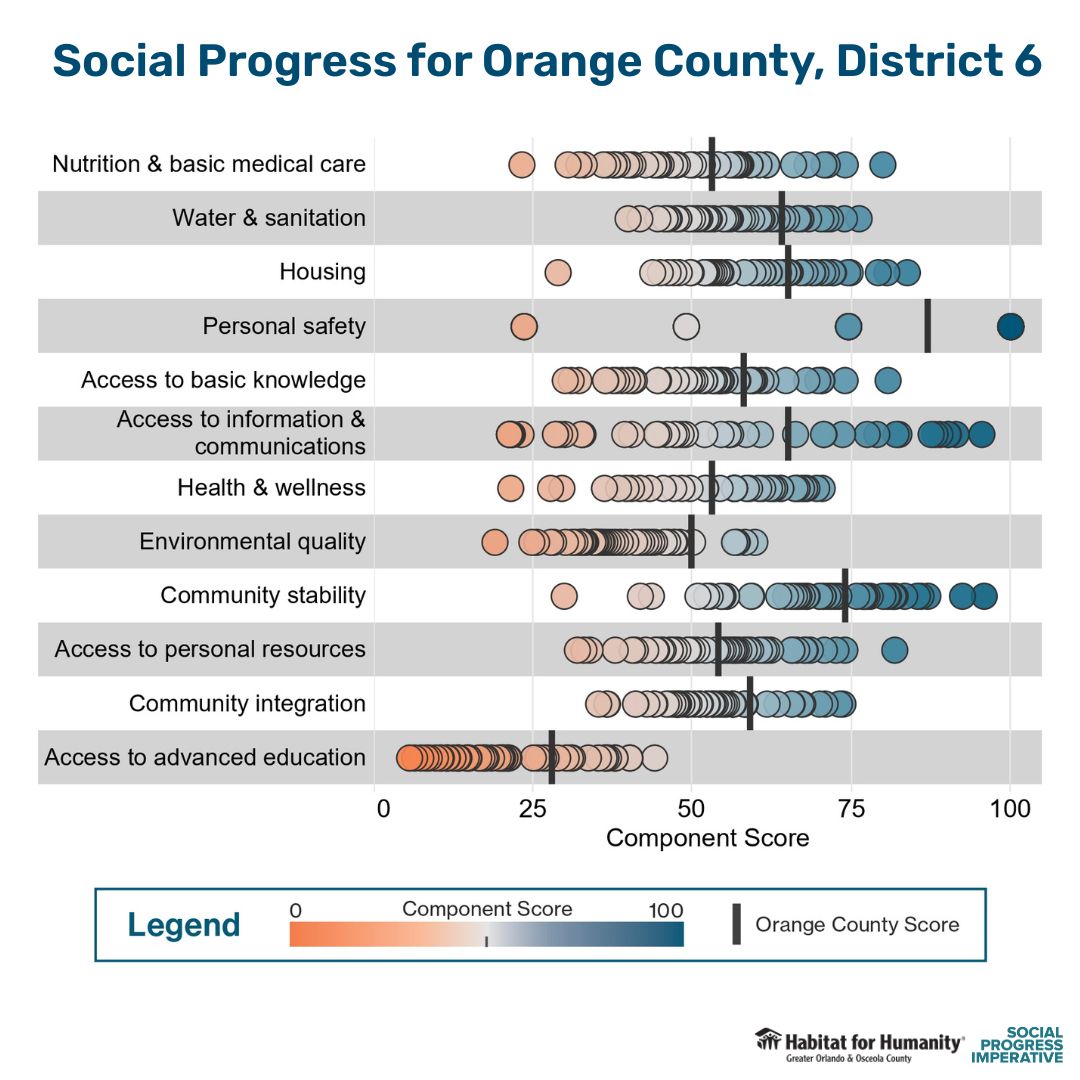
The Florida Community Progress Index provides detailed reports broken down by district level. These localized profiles allow you to analyze component scores, from housing and safety to environmental quality, giving local leaders and advocates the granular insights needed to pinpoint specific community needs and target interventions where they will have the highest impact.
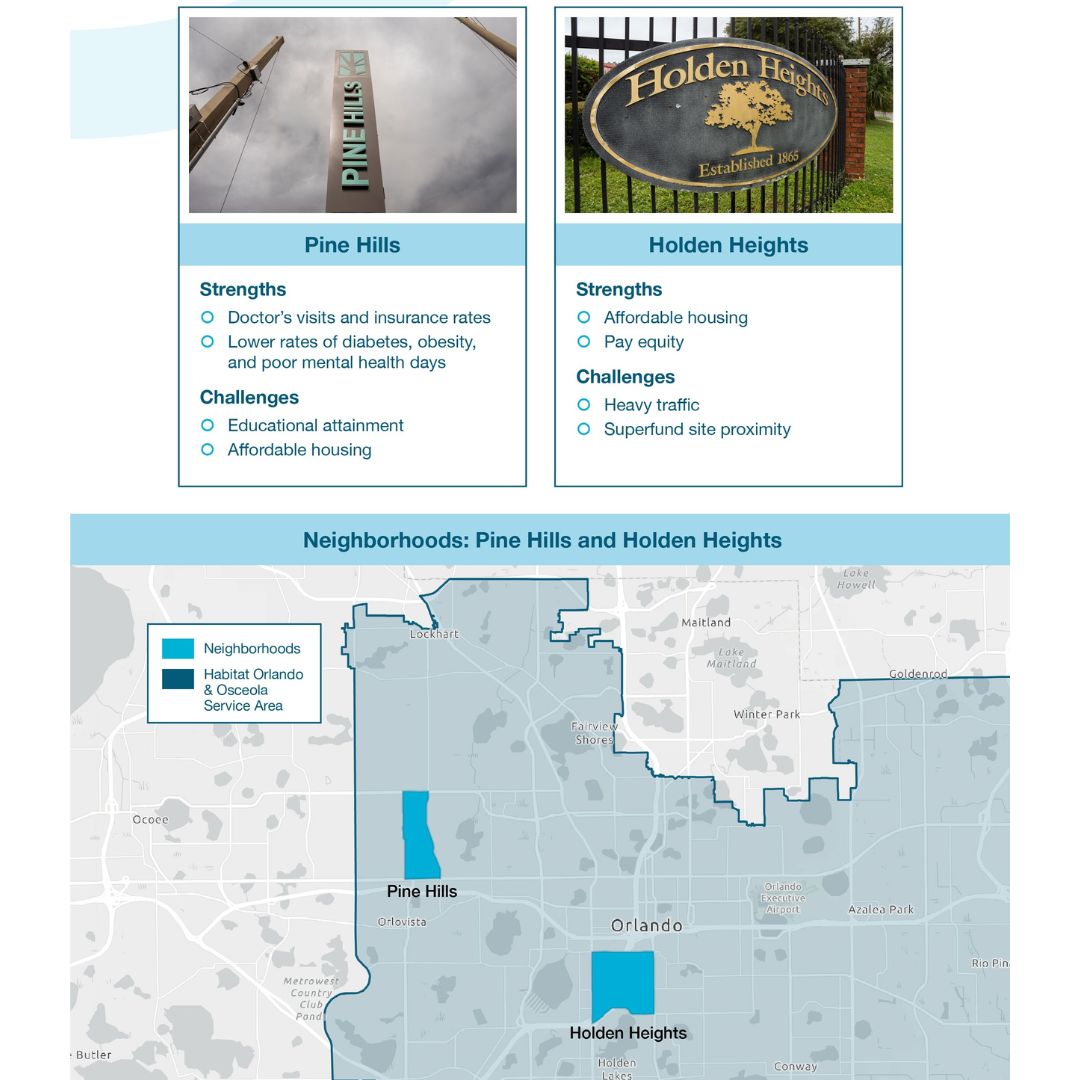
Habitat for Humanity Greater Orlando and Osceola County uses the tool to analyze neighborhood-level data, helping them deploy targeted partnerships, tailored services, and high-impact interventions where they are needed most.
Use Case:
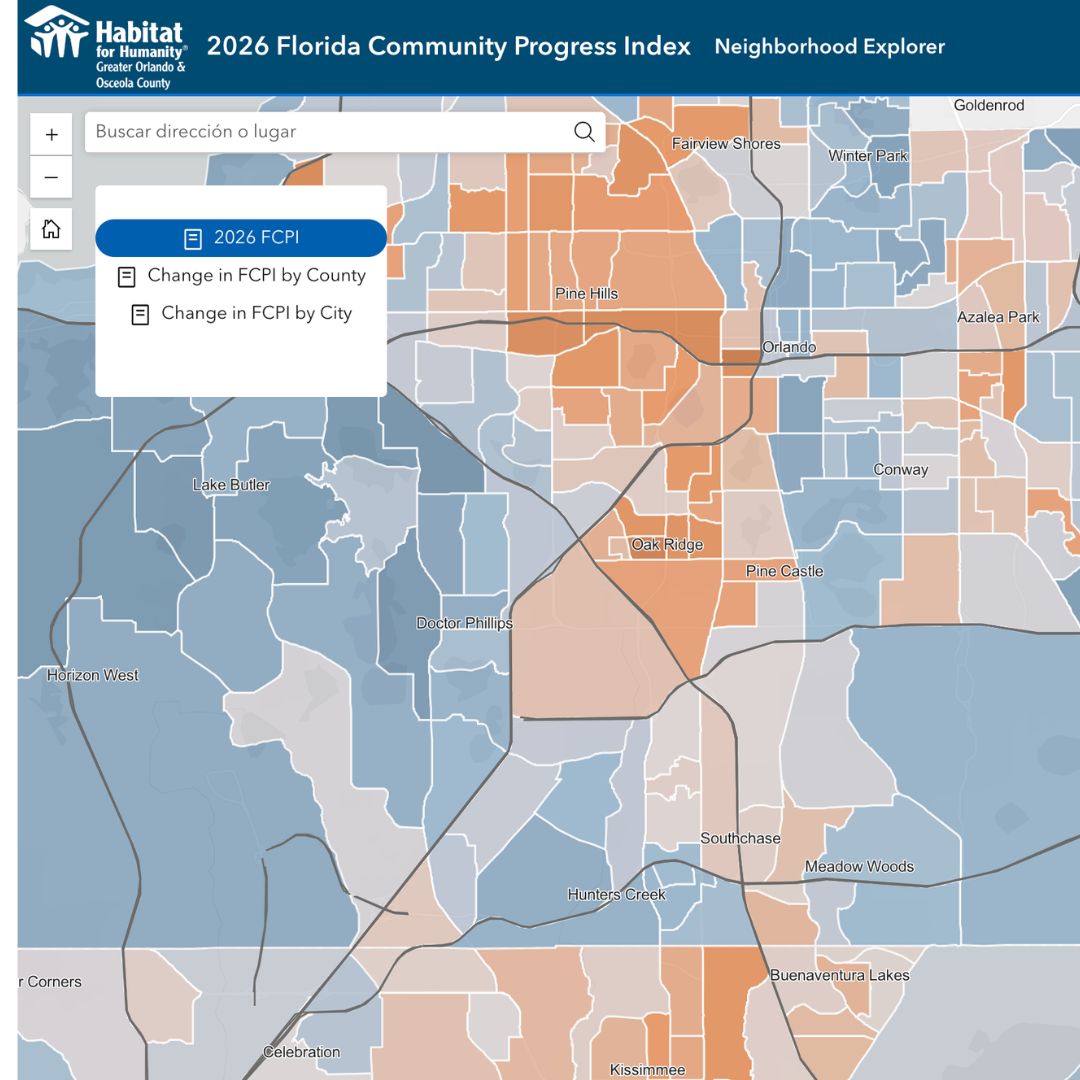
The neighborhood west of I-4, with better health outcomes but struggling housing outcomes, is a part of Pine Hills. It is also the neighborhood where Habitat Orlando & Osceola recently completed their first major home repair.
The neighborhood south of downtown Orlando, with better housing affordability but heavier traffic, is part of Holden Heights. Holden Heights is the same neighborhood where Habitat Orlando & Osceola has constructed more than 60 homes over the course of 35 years. The historic data does not exist to definitively say that housing outcomes are better in Holden Heights today solely because Habitat Orlando & Osceola has built 60 homes there. However, it is an encouraging sign to see that currently housing affordability in Holden Heights is better than regional averages.
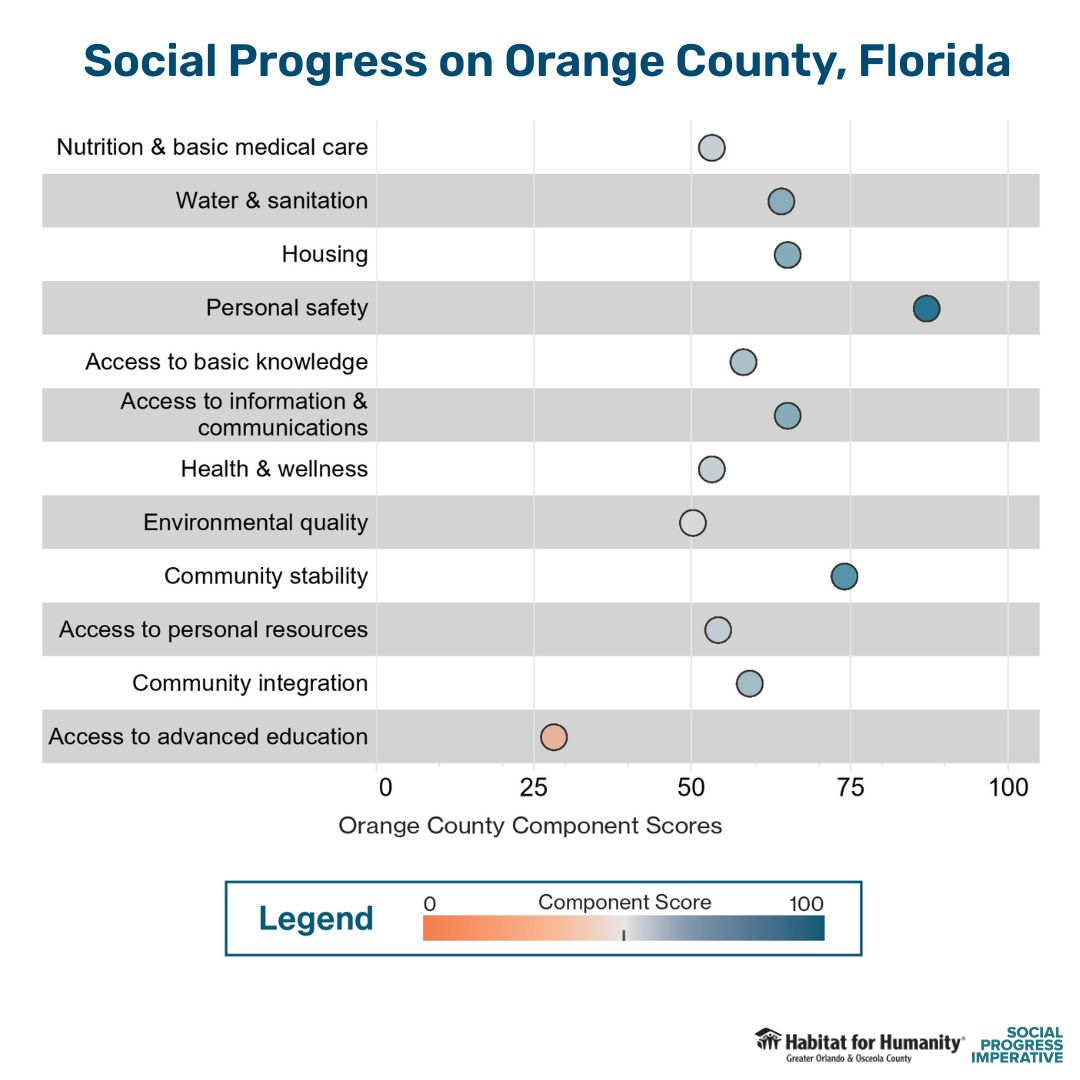
Most neighborhoods in Orange County have values above or near the county average of 56 out of 100. Its community stability score is 74/100, meaning that the county has strong outcomes in homeownership or lower pay gaps. Personal safety is the county’s highest-scoring component, while its advanced education score reflects how advanced degree attainment remains uncommon across the nation as a whole.
Explore in detail how each census tract performs on the Florida Community Progress Index.
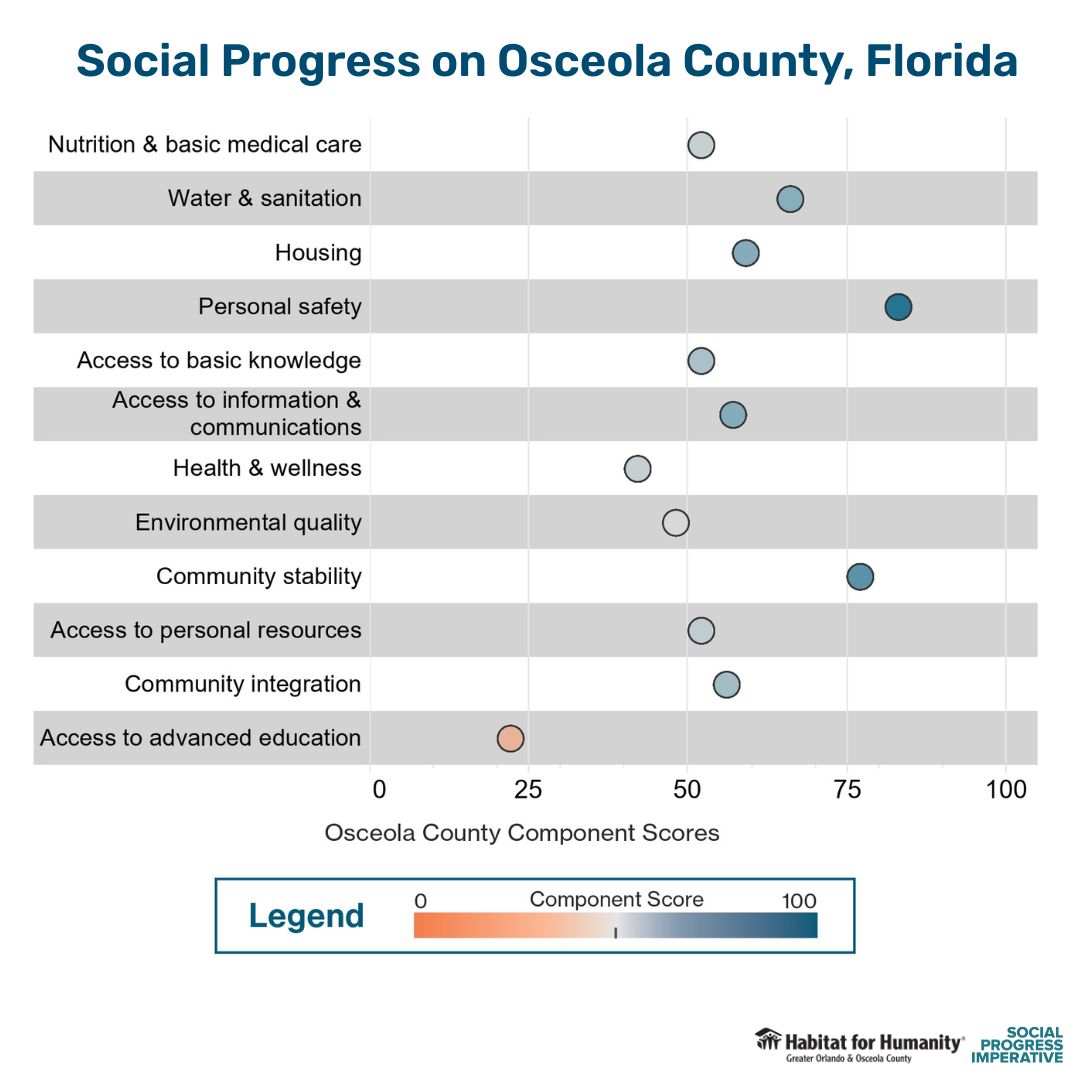
Most neighborhoods in Osceola County have values above or near the county average of 52 out of 100. Its community stability score is high, meaning that the county has strong outcomes in homeownership or lower pay gaps. Osceola County struggles with access to advanced education as well as chronic health conditions, like obesity, diabetes and poor mental health.
Explore in detail how each census tract performs on the Florida Community Progress Index.
According to the Global Social Progress Index, since 2011, the European Union has improved on social progress while the US has declined. However, this is largely due to the US backslide as opposed to the EU making great strides. As we see, social progress has stalled across Europe with the most significant decreases in Austria (-0.77), Lithuania (-0.62), Spain (-0.49), Slovakia (-0.47) and Croatia (-0.41).
In the UK the social progress has declined by 0.39 points since 2011 and it has fallen 8 places in the ranks since 2011 to 21st in 2023. As in the US, the UK decline is largely driven by declining rights and inclusiveness.
Most neighborhoods in Osceola County have values above or near the county average of 52 out of 100. Its community stability score is high, meaning that the county has strong outcomes in homeownership or lower pay gaps. Osceola County struggles with access to advanced education as well as chronic health conditions, like obesity, diabetes and poor mental health.
Explore in detail how each census tract performs on the Florida Community Progress Index.
The Florida Community Progress Index is free from strict economic variables. For example, progress is not measured using income, business starts, or employment rates. This provides a baseline to measure progress that is separate from economic growth.
While there is generally a positive relationship between progress and income, there are neighborhoods with vastly different outcomes despite having the same income levels. See the gray band that captures census tracts with incomes between $60,000 and $65,000 annually. The diversity of FCPI values in this income bracket is large, ranging from neighborhood values well below average at 36 to well above average at 70 (out of a score of 100). Understanding these dynamics at a deeper level, including the role that housing plays in increasing neighborhood progress, is part of next steps for the FCPI.
The Florida Community Progress Index provides detailed reports broken down by district level. These localized profiles allow you to analyze component scores, from housing and safety to environmental quality, giving local leaders and advocates the granular insights needed to pinpoint specific community needs and target interventions where they will have the highest impact.
Habitat for Humanity Greater Orlando and Osceola County uses the tool to analyze neighborhood-level data, helping them deploy targeted partnerships, tailored services, and high-impact interventions where they are needed most.
Use Case:
The neighborhood west of I-4, with better health outcomes but struggling housing outcomes, is a part of Pine Hills. It is also the neighborhood where Habitat Orlando & Osceola recently completed their first major home repair.
The neighborhood south of downtown Orlando, with better housing affordability but heavier traffic, is part of Holden Heights. Holden Heights is the same neighborhood where Habitat Orlando & Osceola has constructed more than 60 homes over the course of 35 years. The historic data does not exist to definitively say that housing outcomes are better in Holden Heights today solely because Habitat Orlando & Osceola has built 60 homes there. However, it is an encouraging sign to see that currently housing affordability in Holden Heights is better than regional averages.
Most neighborhoods in Orange County have values above or near the county average of 56 out of 100. Its community stability score is 74/100, meaning that the county has strong outcomes in homeownership or lower pay gaps. Personal safety is the county’s highest-scoring component, while its advanced education score reflects how advanced degree attainment remains uncommon across the nation as a whole.
Explore in detail how each census tract performs on the Florida Community Progress Index.
Most neighborhoods in Osceola County have values above or near the county average of 52 out of 100. Its community stability score is high, meaning that the county has strong outcomes in homeownership or lower pay gaps. Osceola County struggles with access to advanced education as well as chronic health conditions, like obesity, diabetes and poor mental health.
Explore in detail how each census tract performs on the Florida Community Progress Index.
The Florida Community Progress Index is free from strict economic variables. For example, progress is not measured using income, business starts, or employment rates. This provides a baseline to measure progress that is separate from economic growth.
While there is generally a positive relationship between progress and income, there are neighborhoods with vastly different outcomes despite having the same income levels. See the gray band that captures census tracts with incomes between $60,000 and $65,000 annually. The diversity of FCPI values in this income bracket is large, ranging from neighborhood values well below average at 36 to well above average at 70 (out of a score of 100). Understanding these dynamics at a deeper level, including the role that housing plays in increasing neighborhood progress, is part of next steps for the FCPI.
The Florida Community Progress Index provides detailed reports broken down by district level. These localized profiles allow you to analyze component scores, from housing and safety to environmental quality, giving local leaders and advocates the granular insights needed to pinpoint specific community needs and target interventions where they will have the highest impact.
Habitat for Humanity Greater Orlando and Osceola County uses the tool to analyze neighborhood-level data, helping them deploy targeted partnerships, tailored services, and high-impact interventions where they are needed most.
Use Case:
The neighborhood west of I-4, with better health outcomes but struggling housing outcomes, is a part of Pine Hills. It is also the neighborhood where Habitat Orlando & Osceola recently completed their first major home repair.
The neighborhood south of downtown Orlando, with better housing affordability but heavier traffic, is part of Holden Heights. Holden Heights is the same neighborhood where Habitat Orlando & Osceola has constructed more than 60 homes over the course of 35 years. The historic data does not exist to definitively say that housing outcomes are better in Holden Heights today solely because Habitat Orlando & Osceola has built 60 homes there. However, it is an encouraging sign to see that currently housing affordability in Holden Heights is better than regional averages.
Most neighborhoods in Orange County have values above or near the county average of 56 out of 100. Its community stability score is 74/100, meaning that the county has strong outcomes in homeownership or lower pay gaps. Personal safety is the county’s highest-scoring component, while its advanced education score reflects how advanced degree attainment remains uncommon across the nation as a whole.
Explore in detail how each census tract performs on the Florida Community Progress Index.
Most neighborhoods in Osceola County have values above or near the county average of 52 out of 100. Its community stability score is high, meaning that the county has strong outcomes in homeownership or lower pay gaps. Osceola County struggles with access to advanced education as well as chronic health conditions, like obesity, diabetes and poor mental health.
Explore in detail how each census tract performs on the Florida Community Progress Index.
The Florida Community Progress Index is free from strict economic variables. For example, progress is not measured using income, business starts, or employment rates. This provides a baseline to measure progress that is separate from economic growth.
While there is generally a positive relationship between progress and income, there are neighborhoods with vastly different outcomes despite having the same income levels. See the gray band that captures census tracts with incomes between $60,000 and $65,000 annually. The diversity of FCPI values in this income bracket is large, ranging from neighborhood values well below average at 36 to well above average at 70 (out of a score of 100). Understanding these dynamics at a deeper level, including the role that housing plays in increasing neighborhood progress, is part of next steps for the FCPI.
The Florida Community Progress Index provides detailed reports broken down by district level. These localized profiles allow you to analyze component scores, from housing and safety to environmental quality, giving local leaders and advocates the granular insights needed to pinpoint specific community needs and target interventions where they will have the highest impact.
Habitat for Humanity Greater Orlando and Osceola County uses the tool to analyze neighborhood-level data, helping them deploy targeted partnerships, tailored services, and high-impact interventions where they are needed most.
Use Case:
The neighborhood west of I-4, with better health outcomes but struggling housing outcomes, is a part of Pine Hills. It is also the neighborhood where Habitat Orlando & Osceola recently completed their first major home repair.
The neighborhood south of downtown Orlando, with better housing affordability but heavier traffic, is part of Holden Heights. Holden Heights is the same neighborhood where Habitat Orlando & Osceola has constructed more than 60 homes over the course of 35 years. The historic data does not exist to definitively say that housing outcomes are better in Holden Heights today solely because Habitat Orlando & Osceola has built 60 homes there. However, it is an encouraging sign to see that currently housing affordability in Holden Heights is better than regional averages.
Most neighborhoods in Orange County have values above or near the county average of 56 out of 100. Its community stability score is 74/100, meaning that the county has strong outcomes in homeownership or lower pay gaps. Personal safety is the county’s highest-scoring component, while its advanced education score reflects how advanced degree attainment remains uncommon across the nation as a whole.
Explore in detail how each census tract performs on the Florida Community Progress Index.
Most neighborhoods in Osceola County have values above or near the county average of 52 out of 100. Its community stability score is high, meaning that the county has strong outcomes in homeownership or lower pay gaps. Osceola County struggles with access to advanced education as well as chronic health conditions, like obesity, diabetes and poor mental health.
Explore in detail how each census tract performs on the Florida Community Progress Index.
The Florida Community Progress Index is free from strict economic variables. For example, progress is not measured using income, business starts, or employment rates. This provides a baseline to measure progress that is separate from economic growth.
While there is generally a positive relationship between progress and income, there are neighborhoods with vastly different outcomes despite having the same income levels. See the gray band that captures census tracts with incomes between $60,000 and $65,000 annually. The diversity of FCPI values in this income bracket is large, ranging from neighborhood values well below average at 36 to well above average at 70 (out of a score of 100). Understanding these dynamics at a deeper level, including the role that housing plays in increasing neighborhood progress, is part of next steps for the FCPI.
Most neighborhoods in Osceola County have values above or near the county average of 52 out of 100. Its community stability score is high, meaning that the county has strong outcomes in homeownership or lower pay gaps. Osceola County struggles with access to advanced education as well as chronic health conditions, like obesity, diabetes and poor mental health.
Explore in detail how each census tract performs on the Florida Community Progress Index.
The Florida Community Progress Index provides detailed reports broken down by district level. These localized profiles allow you to analyze component scores, from housing and safety to environmental quality, giving local leaders and advocates the granular insights needed to pinpoint specific community needs and target interventions where they will have the highest impact.
Habitat for Humanity Greater Orlando and Osceola County uses the tool to analyze neighborhood-level data, helping them deploy targeted partnerships, tailored services, and high-impact interventions where they are needed most.
Use Case:
The neighborhood west of I-4, with better health outcomes but struggling housing outcomes, is a part of Pine Hills. It is also the neighborhood where Habitat Orlando & Osceola recently completed their first major home repair.
The neighborhood south of downtown Orlando, with better housing affordability but heavier traffic, is part of Holden Heights. Holden Heights is the same neighborhood where Habitat Orlando & Osceola has constructed more than 60 homes over the course of 35 years. The historic data does not exist to definitively say that housing outcomes are better in Holden Heights today solely because Habitat Orlando & Osceola has built 60 homes there. However, it is an encouraging sign to see that currently housing affordability in Holden Heights is better than regional averages.
Most neighborhoods in Orange County have values above or near the county average of 56 out of 100. Its community stability score is 74/100, meaning that the county has strong outcomes in homeownership or lower pay gaps. Personal safety is the county’s highest-scoring component, while its advanced education score reflects how advanced degree attainment remains uncommon across the nation as a whole.
Explore in detail how each census tract performs on the Florida Community Progress Index.
The Florida Community Progress Index is free from strict economic variables. For example, progress is not measured using income, business starts, or employment rates. This provides a baseline to measure progress that is separate from economic growth.
While there is generally a positive relationship between progress and income, there are neighborhoods with vastly different outcomes despite having the same income levels. See the gray band that captures census tracts with incomes between $60,000 and $65,000 annually. The diversity of FCPI values in this income bracket is large, ranging from neighborhood values well below average at 36 to well above average at 70 (out of a score of 100). Understanding these dynamics at a deeper level, including the role that housing plays in increasing neighborhood progress, is part of next steps for the FCPI.
The Florida Community Progress Index provides detailed reports broken down by district level. These localized profiles allow you to analyze component scores, from housing and safety to environmental quality, giving local leaders and advocates the granular insights needed to pinpoint specific community needs and target interventions where they will have the highest impact.
Habitat for Humanity Greater Orlando and Osceola County uses the tool to analyze neighborhood-level data, helping them deploy targeted partnerships, tailored services, and high-impact interventions where they are needed most.
Use Case:
The neighborhood west of I-4, with better health outcomes but struggling housing outcomes, is a part of Pine Hills. It is also the neighborhood where Habitat Orlando & Osceola recently completed their first major home repair.
The neighborhood south of downtown Orlando, with better housing affordability but heavier traffic, is part of Holden Heights. Holden Heights is the same neighborhood where Habitat Orlando & Osceola has constructed more than 60 homes over the course of 35 years. The historic data does not exist to definitively say that housing outcomes are better in Holden Heights today solely because Habitat Orlando & Osceola has built 60 homes there. However, it is an encouraging sign to see that currently housing affordability in Holden Heights is better than regional averages.
Most neighborhoods in Orange County have values above or near the county average of 56 out of 100. Its community stability score is 74/100, meaning that the county has strong outcomes in homeownership or lower pay gaps. Personal safety is the county’s highest-scoring component, while its advanced education score reflects how advanced degree attainment remains uncommon across the nation as a whole.
Explore in detail how each census tract performs on the Florida Community Progress Index.
Most neighborhoods in Osceola County have values above or near the county average of 52 out of 100. Its community stability score is high, meaning that the county has strong outcomes in homeownership or lower pay gaps. Osceola County struggles with access to advanced education as well as chronic health conditions, like obesity, diabetes and poor mental health.
Explore in detail how each census tract performs on the Florida Community Progress Index.
The Florida Community Progress Index is free from strict economic variables. For example, progress is not measured using income, business starts, or employment rates. This provides a baseline to measure progress that is separate from economic growth.
While there is generally a positive relationship between progress and income, there are neighborhoods with vastly different outcomes despite having the same income levels. See the gray band that captures census tracts with incomes between $60,000 and $65,000 annually. The diversity of FCPI values in this income bracket is large, ranging from neighborhood values well below average at 36 to well above average at 70 (out of a score of 100). Understanding these dynamics at a deeper level, including the role that housing plays in increasing neighborhood progress, is part of next steps for the FCPI.
The Florida Community Progress Index provides detailed reports broken down by district level. These localized profiles allow you to analyze component scores, from housing and safety to environmental quality, giving local leaders and advocates the granular insights needed to pinpoint specific community needs and target interventions where they will have the highest impact.
Habitat for Humanity Greater Orlando and Osceola County uses the tool to analyze neighborhood-level data, helping them deploy targeted partnerships, tailored services, and high-impact interventions where they are needed most.
Use Case:
The neighborhood west of I-4, with better health outcomes but struggling housing outcomes, is a part of Pine Hills. It is also the neighborhood where Habitat Orlando & Osceola recently completed their first major home repair.
The neighborhood south of downtown Orlando, with better housing affordability but heavier traffic, is part of Holden Heights. Holden Heights is the same neighborhood where Habitat Orlando & Osceola has constructed more than 60 homes over the course of 35 years. The historic data does not exist to definitively say that housing outcomes are better in Holden Heights today solely because Habitat Orlando & Osceola has built 60 homes there. However, it is an encouraging sign to see that currently housing affordability in Holden Heights is better than regional averages.
The Florida Community Progress Index is free from strict economic variables. For example, progress is not measured using income, business starts, or employment rates. This provides a baseline to measure progress that is separate from economic growth.
While there is generally a positive relationship between progress and income, there are neighborhoods with vastly different outcomes despite having the same income levels. See the gray band that captures census tracts with incomes between $60,000 and $65,000 annually. The diversity of FCPI values in this income bracket is large, ranging from neighborhood values well below average at 36 to well above average at 70 (out of a score of 100). Understanding these dynamics at a deeper level, including the role that housing plays in increasing neighborhood progress, is part of next steps for the FCPI.
The Florida Community Progress Index provides detailed reports broken down by district level. These localized profiles allow you to analyze component scores, from housing and safety to environmental quality, giving local leaders and advocates the granular insights needed to pinpoint specific community needs and target interventions where they will have the highest impact.
The Florida Community Progress Index is free from strict economic variables. For example, progress is not measured using income, business starts, or employment rates. This provides a baseline to measure progress that is separate from economic growth.
While there is generally a positive relationship between progress and income, there are neighborhoods with vastly different outcomes despite having the same income levels. See the gray band that captures census tracts with incomes between $60,000 and $65,000 annually. The diversity of FCPI values in this income bracket is large, ranging from neighborhood values well below average at 36 to well above average at 70 (out of a score of 100). Understanding these dynamics at a deeper level, including the role that housing plays in increasing neighborhood progress, is part of next steps for the FCPI.
The Florida Community Progress Index provides detailed reports broken down by district level. These localized profiles allow you to analyze component scores, from housing and safety to environmental quality, giving local leaders and advocates the granular insights needed to pinpoint specific community needs and target interventions where they will have the highest impact.
The Florida Community Progress Index provides detailed reports broken down by district level. These localized profiles allow you to analyze component scores, from housing and safety to environmental quality, giving local leaders and advocates the granular insights needed to pinpoint specific community needs and target interventions where they will have the highest impact.
The Florida Community Progress Index provides detailed reports broken down by district level. These localized profiles allow you to analyze component scores, from housing and safety to environmental quality, giving local leaders and advocates the granular insights needed to pinpoint specific community needs and target interventions where they will have the highest impact.
The Florida Community Progress Index is free from strict economic variables. For example, progress is not measured using income, business starts, or employment rates. This provides a baseline to measure progress that is separate from economic growth.
While there is generally a positive relationship between progress and income, there are neighborhoods with vastly different outcomes despite having the same income levels. See the gray band that captures census tracts with incomes between $60,000 and $65,000 annually. The diversity of FCPI values in this income bracket is large, ranging from neighborhood values well below average at 36 to well above average at 70 (out of a score of 100). Understanding these dynamics at a deeper level, including the role that housing plays in increasing neighborhood progress, is part of next steps for the FCPI.
The Florida Community Progress Index is free from strict economic variables. For example, progress is not measured using income, business starts, or employment rates. This provides a baseline to measure progress that is separate from economic growth.
While there is generally a positive relationship between progress and income, there are neighborhoods with vastly different outcomes despite having the same income levels. See the gray band that captures census tracts with incomes between $60,000 and $65,000 annually. The diversity of FCPI values in this income bracket is large, ranging from neighborhood values well below average at 36 to well above average at 70 (out of a score of 100). Understanding these dynamics at a deeper level, including the role that housing plays in increasing neighborhood progress, is part of next steps for the FCPI.


The Florida Community Progress Index is free from strict economic variables. For example, progress is not measured using income, business starts, or employment rates. This provides a baseline to measure progress that is separate from economic growth.
While there is generally a positive relationship between progress and income, there are neighborhoods with vastly different outcomes despite having the same income levels. See the gray band that captures census tracts with incomes between $60,000 and $65,000 annually. The diversity of FCPI values in this income bracket is large, ranging from neighborhood values well below average at 36 to well above average at 70 (out of a score of 100). Understanding these dynamics at a deeper level, including the role that housing plays in increasing neighborhood progress, is part of next steps for the FCPI.
The Florida Community Progress Index provides detailed reports broken down by district level. These localized profiles allow you to analyze component scores, from housing and safety to environmental quality, giving local leaders and advocates the granular insights needed to pinpoint specific community needs and target interventions where they will have the highest impact.
Habitat for Humanity Greater Orlando and Osceola County uses the tool to analyze neighborhood-level data, helping them deploy targeted partnerships, tailored services, and high-impact interventions where they are needed most.
Use Case:
The neighborhood west of I-4, with better health outcomes but struggling housing outcomes, is a part of Pine Hills. It is also the neighborhood where Habitat Orlando & Osceola recently completed their first major home repair.
The neighborhood south of downtown Orlando, with better housing affordability but heavier traffic, is part of Holden Heights. Holden Heights is the same neighborhood where Habitat Orlando & Osceola has constructed more than 60 homes over the course of 35 years. The historic data does not exist to definitively say that housing outcomes are better in Holden Heights today solely because Habitat Orlando & Osceola has built 60 homes there. However, it is an encouraging sign to see that currently housing affordability in Holden Heights is better than regional averages.
Most neighborhoods in Orange County have values above or near the county average of 56 out of 100. Its community stability score is 74/100, meaning that the county has strong outcomes in homeownership or lower pay gaps. Personal safety is the county’s highest-scoring component, while its advanced education score reflects how advanced degree attainment remains uncommon across the nation as a whole.
Explore in detail how each census tract performs on the Florida Community Progress Index.
Solutions to develop high quality products.
The Florida Community Progress Index is free from strict economic variables. For example, progress is not measured using income, business starts, or employment rates. This provides a baseline to measure progress that is separate from economic growth.
While there is generally a positive relationship between progress and income, there are neighborhoods with vastly different outcomes despite having the same income levels. See the gray band that captures census tracts with incomes between $60,000 and $65,000 annually. The diversity of FCPI values in this income bracket is large, ranging from neighborhood values well below average at 36 to well above average at 70 (out of a score of 100). Understanding these dynamics at a deeper level, including the role that housing plays in increasing neighborhood progress, is part of next steps for the FCPI.
The Florida Community Progress Index provides detailed reports broken down by district level. These localized profiles allow you to analyze component scores, from housing and safety to environmental quality, giving local leaders and advocates the granular insights needed to pinpoint specific community needs and target interventions where they will have the highest impact.
Habitat for Humanity Greater Orlando and Osceola County uses the tool to analyze neighborhood-level data, helping them deploy targeted partnerships, tailored services, and high-impact interventions where they are needed most.
Use Case:
The neighborhood west of I-4, with better health outcomes but struggling housing outcomes, is a part of Pine Hills. It is also the neighborhood where Habitat Orlando & Osceola recently completed their first major home repair.
The neighborhood south of downtown Orlando, with better housing affordability but heavier traffic, is part of Holden Heights. Holden Heights is the same neighborhood where Habitat Orlando & Osceola has constructed more than 60 homes over the course of 35 years. The historic data does not exist to definitively say that housing outcomes are better in Holden Heights today solely because Habitat Orlando & Osceola has built 60 homes there. However, it is an encouraging sign to see that currently housing affordability in Holden Heights is better than regional averages.
Most neighborhoods in Orange County have values above or near the county average of 56 out of 100. Its community stability score is 74/100, meaning that the county has strong outcomes in homeownership or lower pay gaps. Personal safety is the county’s highest-scoring component, while its advanced education score reflects how advanced degree attainment remains uncommon across the nation as a whole.
Explore in detail how each census tract performs on the Florida Community Progress Index.
Most neighborhoods in Osceola County have values above or near the county average of 52 out of 100. Its community stability score is high, meaning that the county has strong outcomes in homeownership or lower pay gaps. Osceola County struggles with access to advanced education as well as chronic health conditions, like obesity, diabetes and poor mental health.
Explore in detail how each census tract performs on the Florida Community Progress Index.
In this brief interview, Sofía Ramírez, director of México ¿cómo vamos? highlights six key takeaways from their latest report and the lessons Mexico offers as a diverse country. She also shares how they collaborate with policymakers and leaders across sectors to track and amplify the impact of their work.
Explore the full results and learn more about the six main challenges Mexico faces in social progress.
With more than 40 social and environmental outcomes, the Florida Community Progress Index offers a detailed view of Floridian neighborhoods across the United States.
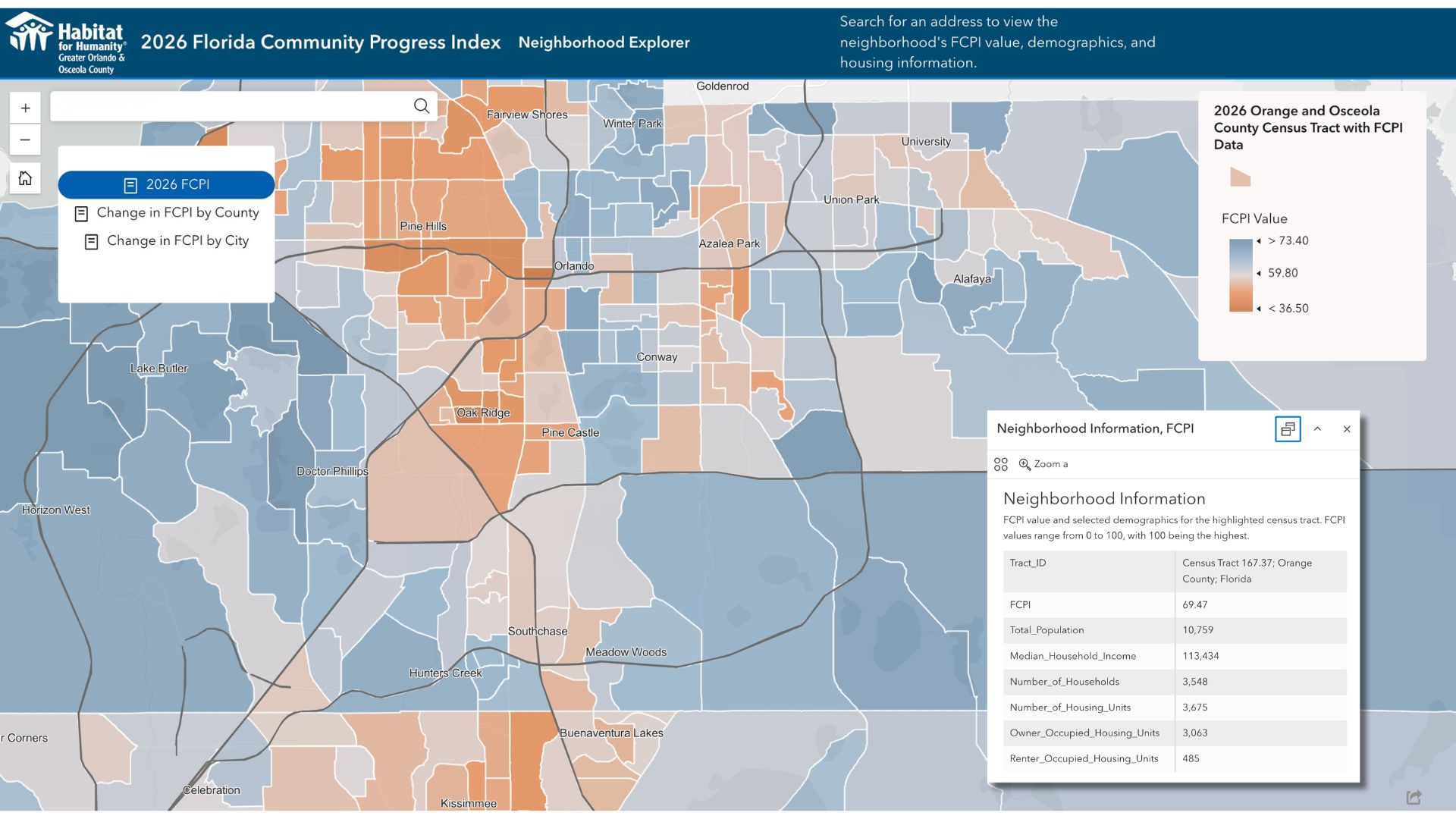
With more than 40 social and environmental outcomes, the Florida Community Progress Index offers a detailed view of Floridian neighborhoods across the United States.
.gif)

Download district-level progress reports. They help identify both community strengths and challenges in the district or county analyzed by the FCPI. They also highlight areas where local governments and nonprofits have already invested significant energy and identify areas for continued improvement.
The India Dialogue, hosted at Stanford University, brought together leaders from various sectors to share insights on how India can tackle social challenges and enhance policymaking. The plan of action presented at the event focuses on innovation, social progress, and competitiveness as key pillars.
Improving wellbeing for the new generations across the world, the Youth Progress Index is a data insights tool used by governments, youth organizations and civil society to advocate for better social opportunities for the youth for their present and future.

Social Progress Insights is a series of short briefs aiming to provide insights on the current state of the world based on the Social Progress Index.

Ready to advance social progress in your community?