
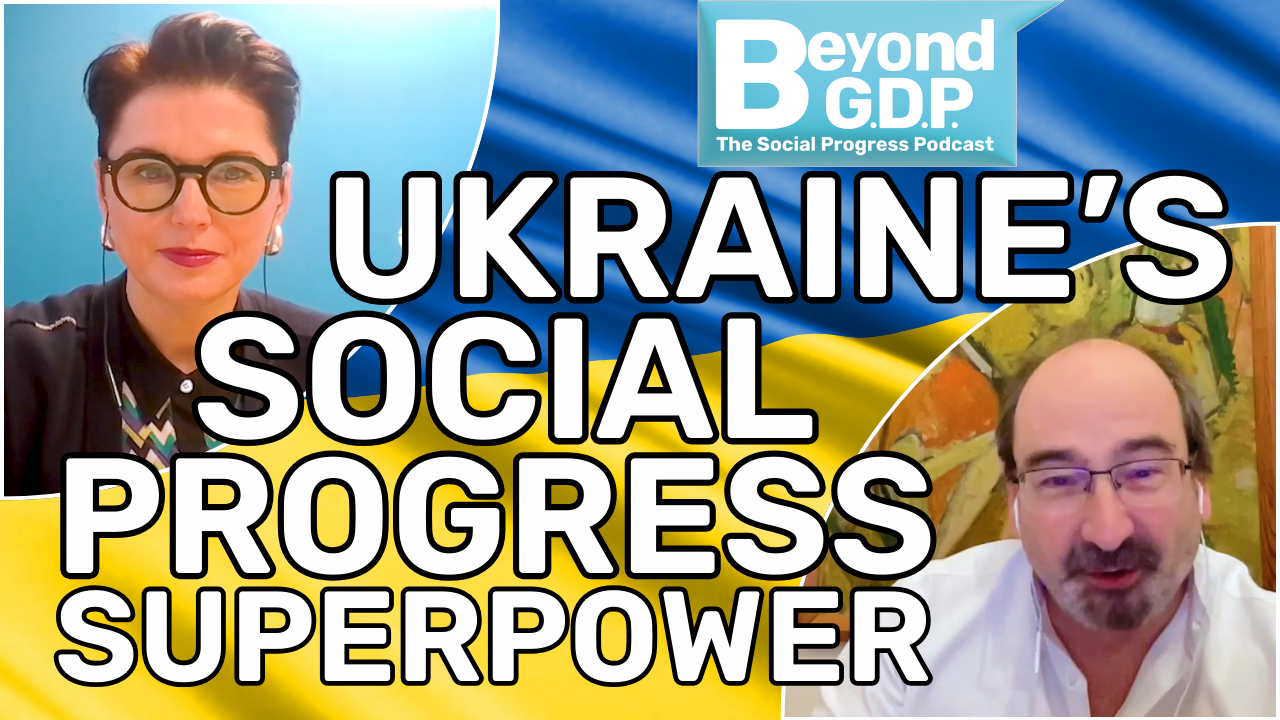
The true foundation of Ukraine’s resistance lies in a powerful, often misunderstood, civic society that has defied expectations for decades.
In Episode 4 of Beyond GDP: The Social Progress Podcast, host Michael Green sits down with Orysia Lutsevych, Head of the Ukraine Forum at Chatham House and Deputy Director, Russia and Eurasia Programme, to discuss why the war's outcome is key for shaping our global system, and why Ukraine was set up for this fight long before 2022.
Lutsevych explains that: “Ukraine has been underestimated and Russia has been overestimated for obvious reasons. I think Ukraine was one of the largest unknown or misunderstood countries in Europe before the full-scale invasion.”
Before the invasion, Ukraine had a reputation problem. If you asked most people, the answer might have been "corruption." Yet, the data tells a completely different story.
Michael Green points to the Global Social Progress Index, which shows that, even before the war, Ukraine was among the world's most successful countries at turning its modest GDP per capita into strong social outcomes.
Lutsevych confirms this, explaining that there has been an enormous, persistent energy among the Ukrainian people and companies to build a better country. The conversation reveals:
As the war drags on, questions arise about exhaustion. Lutsevych confirms that while perseverance remains strong, the country faces two enemies: the external invader and the internal threat of corruption.
This conflict is far more than a regional dispute; it is about the future structure of international law and sovereignty.
Lutsevych frames the war as a battle against the fundamental belief that some countries should have limited sovereignty.
The hosts discuss:
The episode concludes with Orysia Lutsevych sharing her prediction for how the war will turn the tide this winter and what the ultimate cost of this conflict will be for Russia.
Finally, we address the most important question: What can listeners do right now to support Ukraine? Ludsevich offers specific, actionable advice on where to focus support to amplify voices on the ground.
Don't miss this critical conversation on the future of sovereignty and social progress.
The true foundation of Ukraine’s resistance lies in a powerful, often misunderstood, civic society that has defied expectations for decades.
In Episode 4 of Beyond GDP: The Social Progress Podcast, host Michael Green sits down with Orysia Lutsevych, Head of the Ukraine Forum at Chatham House and Deputy Director, Russia and Eurasia Programme, to discuss why the war's outcome is key for shaping our global system, and why Ukraine was set up for this fight long before 2022.
Lutsevych explains that: “Ukraine has been underestimated and Russia has been overestimated for obvious reasons. I think Ukraine was one of the largest unknown or misunderstood countries in Europe before the full-scale invasion.”
Before the invasion, Ukraine had a reputation problem. If you asked most people, the answer might have been "corruption." Yet, the data tells a completely different story.
Michael Green points to the Global Social Progress Index, which shows that, even before the war, Ukraine was among the world's most successful countries at turning its modest GDP per capita into strong social outcomes.
Lutsevych confirms this, explaining that there has been an enormous, persistent energy among the Ukrainian people and companies to build a better country. The conversation reveals:
As the war drags on, questions arise about exhaustion. Lutsevych confirms that while perseverance remains strong, the country faces two enemies: the external invader and the internal threat of corruption.
This conflict is far more than a regional dispute; it is about the future structure of international law and sovereignty.
Lutsevych frames the war as a battle against the fundamental belief that some countries should have limited sovereignty.
The hosts discuss:
The episode concludes with Orysia Lutsevych sharing her prediction for how the war will turn the tide this winter and what the ultimate cost of this conflict will be for Russia.
Finally, we address the most important question: What can listeners do right now to support Ukraine? Ludsevich offers specific, actionable advice on where to focus support to amplify voices on the ground.
Don't miss this critical conversation on the future of sovereignty and social progress.


.png)

.jpg)

