
When we look at elections, the narrative usually centers on promises of transformation, economic expansion, or fresh starts. But what happens when an entire nation holds together not by alignment with a vision, but by a collective effort to keep the alternative out?
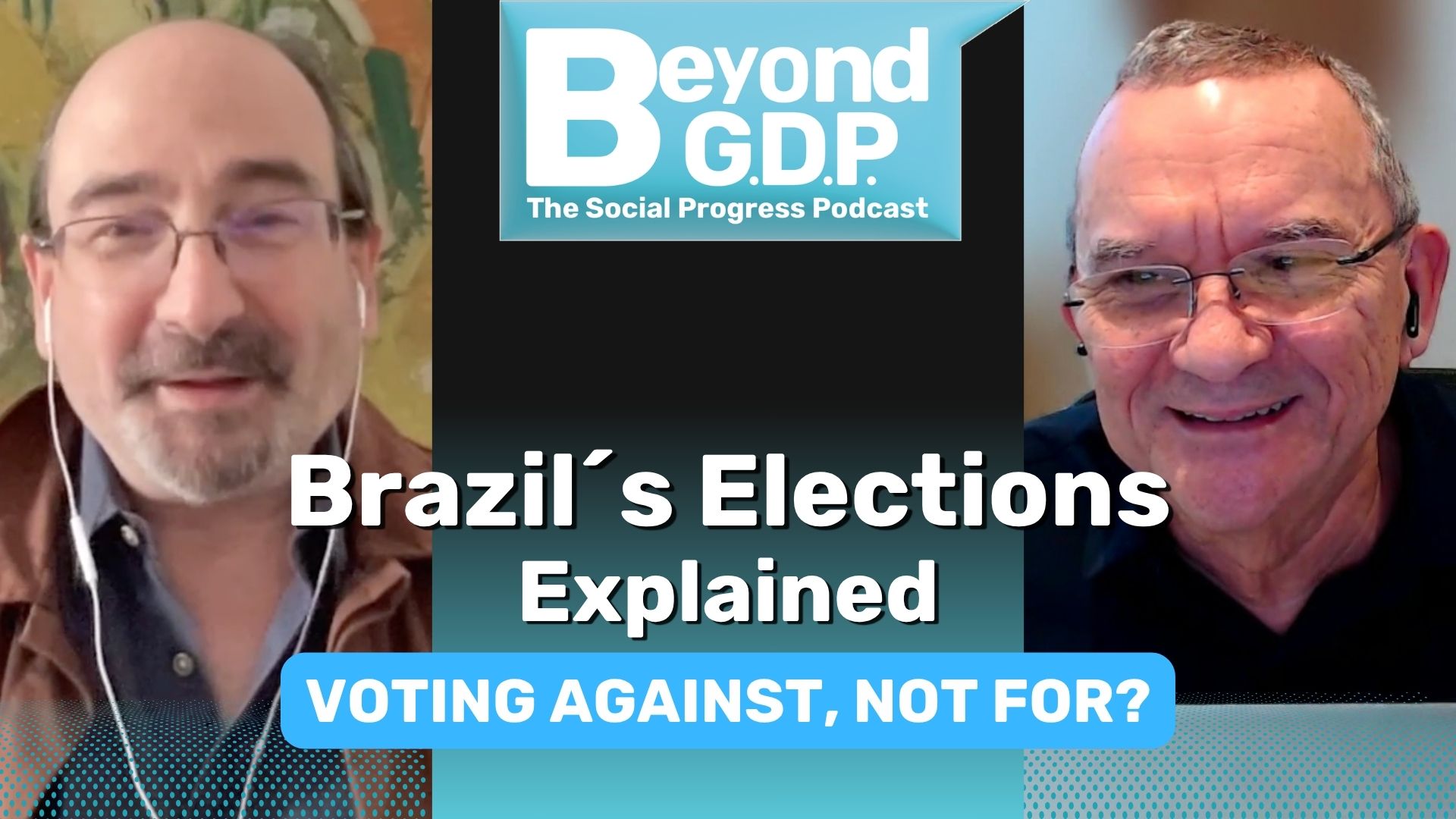
This is the core dilemma defining the face-off between presidential candidates President Lula da Silva and Flávio Bolsonaro, where voter rejection on both sides far outweighs genuine enthusiasm for a different future. In our latest episode of Beyond GDP: The Social Progress Podcast, Dr. Ricardo Chaves Lima analyzes Brazil’s upcoming presidential and legislative elections on October 4th. Dr. Chaves has a Ph.D. from the University of Tennessee in Knoxville; he is currently a professor at the Federal University of Pernambuco and is a close partner of IPS Brasil.
The incoming president faces global and domestic crises: navigating trade tensions with the U.S., balancing BRICS agreements, managing the climate crisis with some deniers still in power, and repairing a broken education system.
For our international listeners, Brazil’s story is crucial to understanding how populism works in Latin America. The shadow of Jair Bolsonaro’s term in office runs far deeper than his son carrying his surname on the ballot. It altered voter psychology and tapped into raw anti-establishment anger, forcing us to ask: is populism just a phase, or is it so embedded that leaders can keep bypassing traditional institutions to stay in power, as we see in the U.S. and across Latin America?
In this episode, we don’t offer campaign predictions. Instead, we pull back the curtain on how budgetary power, institutional barriers, populism and voter psychology will impact the result on October 4th.
When we look at elections, the narrative usually centers on promises of transformation, economic expansion, or fresh starts. But what happens when an entire nation holds together not by alignment with a vision, but by a collective effort to keep the alternative out?
This is the core dilemma defining the face-off between presidential candidates President Lula da Silva and Flávio Bolsonaro, where voter rejection on both sides far outweighs genuine enthusiasm for a different future. In our latest episode of Beyond GDP: The Social Progress Podcast, Dr. Ricardo Chaves Lima analyzes Brazil’s upcoming presidential and legislative elections on October 4th. Dr. Chaves has a Ph.D. from the University of Tennessee in Knoxville; he is currently a professor at the Federal University of Pernambuco and is a close partner of IPS Brasil.
The incoming president faces global and domestic crises: navigating trade tensions with the U.S., balancing BRICS agreements, managing the climate crisis with some deniers still in power, and repairing a broken education system.
For our international listeners, Brazil’s story is crucial to understanding how populism works in Latin America. The shadow of Jair Bolsonaro’s term in office runs far deeper than his son carrying his surname on the ballot. It altered voter psychology and tapped into raw anti-establishment anger, forcing us to ask: is populism just a phase, or is it so embedded that leaders can keep bypassing traditional institutions to stay in power, as we see in the U.S. and across Latin America?
In this episode, we don’t offer campaign predictions. Instead, we pull back the curtain on how budgetary power, institutional barriers, populism and voter psychology will impact the result on October 4th.




.jpg)

