
It’s clear that leaders and researchers across the world are no longer satisfied with just “growth.” We build the Index because we believe leaders deserve clarity; a framework to talk about the things that actually impact people’s lives every day, like health, clean water, and rights. The index is a roadmap for action, ready for you to make data-driven decisions.
We respond to the most frequently asked questions about the Global Social Progress Index:
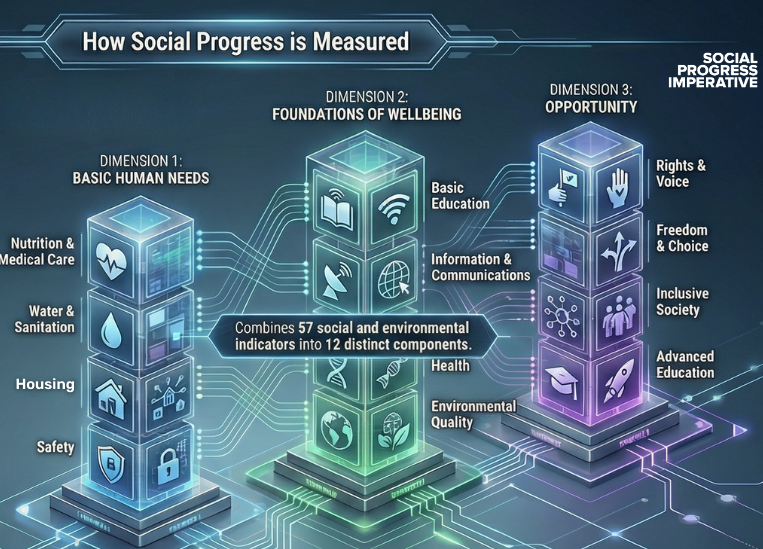
We don't measure "inputs" like a government's spending; we measure outcomes. Our framework is built on 57 social and environmental outcome indicators that capture citizens' lived experience. For example, we don’t look at how much is spent on healthcare, but whether people are healthy.
Rankings don’t tell the full story and are not the only data insights we provide. For example, the relative performance analysis we include is key for decisionmakers. By comparing countries with similar GDP per capita, we can see who is effectively over-performing by turning their resources into wellbeing and who is under-performing relative to their wealth. This allows leaders to identify the specific areas where they are lagging behind their economic peers. It transforms a score into a targeted roadmap for policy and investment.
The Social Progress Index is trusted by governments and organizations that manage the world’s most critical resources. Organizations that use the global index range from global investment firms and top-tier consultants advising governments and corporations, to researchers, industrial leaders building the world’s infrastructure and specialized analysts predicting global shifts. These professionals integrate our full data to see trends others miss. You can also unlock the full dataset by opting for premium access.
We also closely collaborate with organizations interested in developing specific data tools for the communities they serve. Explore more about our partners.
We want our data to be the engine for your insights.Our users integrate the Index directly into their own tools or use it to inform their reports and projects, create ESG strategies, support risk management, or identify vulnerabilities and opportunities. Learn more.
We asked our CEO, Michael Green, to respond to this important question in this short video.
One of our most popular questions! The index is built on a transparent, robust methodology. Researchers worldwide use the index for their analyses. Notably, the Social Progress Index has 600+ references in more than 130 academic papers. Additionally, a number of lecturers have reached out to request premium access for their classes or institutions. If you are interested in providing this opportunity to your students, contact us.
We are here to ensure you have the most rigorous evidence-based data to turn your ambitions into action.
It’s clear that leaders and researchers across the world are no longer satisfied with just “growth.” We build the Index because we believe leaders deserve clarity; a framework to talk about the things that actually impact people’s lives every day, like health, clean water, and rights. The index is a roadmap for action, ready for you to make data-driven decisions.
We respond to the most frequently asked questions about the Global Social Progress Index:
We don't measure "inputs" like a government's spending; we measure outcomes. Our framework is built on 57 social and environmental outcome indicators that capture citizens' lived experience. For example, we don’t look at how much is spent on healthcare, but whether people are healthy.
Rankings don’t tell the full story and are not the only data insights we provide. For example, the relative performance analysis we include is key for decisionmakers. By comparing countries with similar GDP per capita, we can see who is effectively over-performing by turning their resources into wellbeing and who is under-performing relative to their wealth. This allows leaders to identify the specific areas where they are lagging behind their economic peers. It transforms a score into a targeted roadmap for policy and investment.
The Social Progress Index is trusted by governments and organizations that manage the world’s most critical resources. Organizations that use the global index range from global investment firms and top-tier consultants advising governments and corporations, to researchers, industrial leaders building the world’s infrastructure and specialized analysts predicting global shifts. These professionals integrate our full data to see trends others miss. You can also unlock the full dataset by opting for premium access.
We also closely collaborate with organizations interested in developing specific data tools for the communities they serve. Explore more about our partners.
We want our data to be the engine for your insights.Our users integrate the Index directly into their own tools or use it to inform their reports and projects, create ESG strategies, support risk management, or identify vulnerabilities and opportunities. Learn more.
We asked our CEO, Michael Green, to respond to this important question in this short video.
One of our most popular questions! The index is built on a transparent, robust methodology. Researchers worldwide use the index for their analyses. Notably, the Social Progress Index has 600+ references in more than 130 academic papers. Additionally, a number of lecturers have reached out to request premium access for their classes or institutions. If you are interested in providing this opportunity to your students, contact us.
We are here to ensure you have the most rigorous evidence-based data to turn your ambitions into action.

.jpg)


.jpg)

