
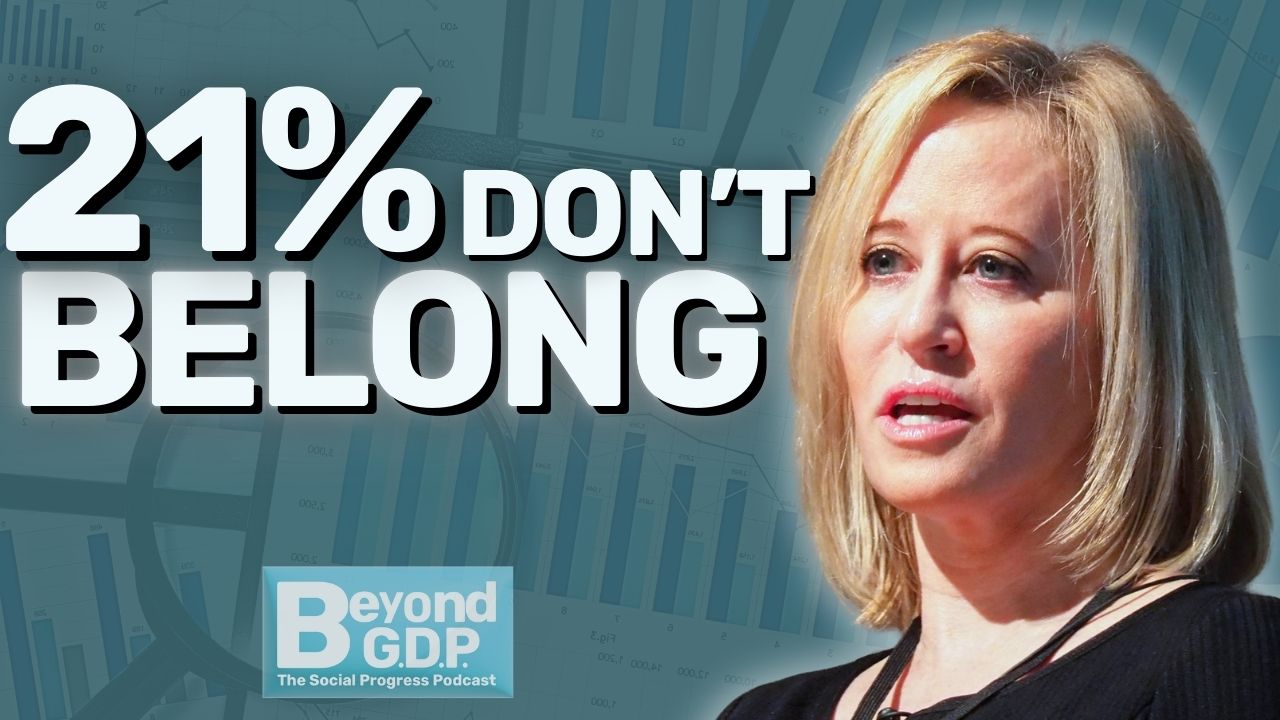
Kim Samuel’s groundbreaking work suggests that social inclusion and a sense of community are not just feel-good concepts but measurable indicators that can influence societal progress. If you're curious about how belonging can redefine our approach to social development and policy, watch or listen to the full episode now.
Michael Green and Kim Samuel discuss how belonging matters more than ever in the second episode of Beyond GDP: The Social Progress Podcast. Kim Samuel is a leading voice in the global movement for belonging. She is the founder of the Belonging Forum, a global research, advocacy, and action organization that works to heal the crisis of social isolation and build belonging around the world.
The concept of belonging has gained renewed relevance. Kim highlights that belonging isn't merely a comforting emotion but a fundamental human right, something innate that we are born with. She emphasizes that belonging manifests as a measurable outcome, much like life expectancy or educational attainment, and plays a critical role in how societies progress or stall.
This insight shifts the focus from subjective feelings to tangible metrics that reflect societal health. It also highlights that systems governing us, policies, resource allocation or community engagement are all influenced by how we measure and prioritize belonging.
Kim's distinctive framework divides the concept into four interconnected "P" words:
Kim has seen that these elements can reduce social isolation and improve societal wellbeing. For example, marginalized groups often experience disconnection in one or more of these dimensions, hindering their social inclusion and opportunities.
Michael Green and Kim Samuel argue that measuring belonging isn't just academic, it's critical for shaping policies that create inclusive communities. Kim advocates integrating belonging metrics into social and economic policymaking, much like how inflation or unemployment rates are used to gauge economic health. For instance, her work showed that in regions with stronger social cohesion and community engagement, people report higher happiness and lower loneliness, regardless of income levels. Conversely, neglected communities, even affluent ones, can suffer from social disconnection and lack of purpose.
Listen now to learn the practical steps to create a culture of belonging.
Kim Samuel’s groundbreaking work suggests that social inclusion and a sense of community are not just feel-good concepts but measurable indicators that can influence societal progress. If you're curious about how belonging can redefine our approach to social development and policy, watch or listen to the full episode now.
Michael Green and Kim Samuel discuss how belonging matters more than ever in the second episode of Beyond GDP: The Social Progress Podcast. Kim Samuel is a leading voice in the global movement for belonging. She is the founder of the Belonging Forum, a global research, advocacy, and action organization that works to heal the crisis of social isolation and build belonging around the world.
The concept of belonging has gained renewed relevance. Kim highlights that belonging isn't merely a comforting emotion but a fundamental human right, something innate that we are born with. She emphasizes that belonging manifests as a measurable outcome, much like life expectancy or educational attainment, and plays a critical role in how societies progress or stall.
This insight shifts the focus from subjective feelings to tangible metrics that reflect societal health. It also highlights that systems governing us, policies, resource allocation or community engagement are all influenced by how we measure and prioritize belonging.
Kim's distinctive framework divides the concept into four interconnected "P" words:
Kim has seen that these elements can reduce social isolation and improve societal wellbeing. For example, marginalized groups often experience disconnection in one or more of these dimensions, hindering their social inclusion and opportunities.
Michael Green and Kim Samuel argue that measuring belonging isn't just academic, it's critical for shaping policies that create inclusive communities. Kim advocates integrating belonging metrics into social and economic policymaking, much like how inflation or unemployment rates are used to gauge economic health. For instance, her work showed that in regions with stronger social cohesion and community engagement, people report higher happiness and lower loneliness, regardless of income levels. Conversely, neglected communities, even affluent ones, can suffer from social disconnection and lack of purpose.
Listen now to learn the practical steps to create a culture of belonging.



.jpg)

