

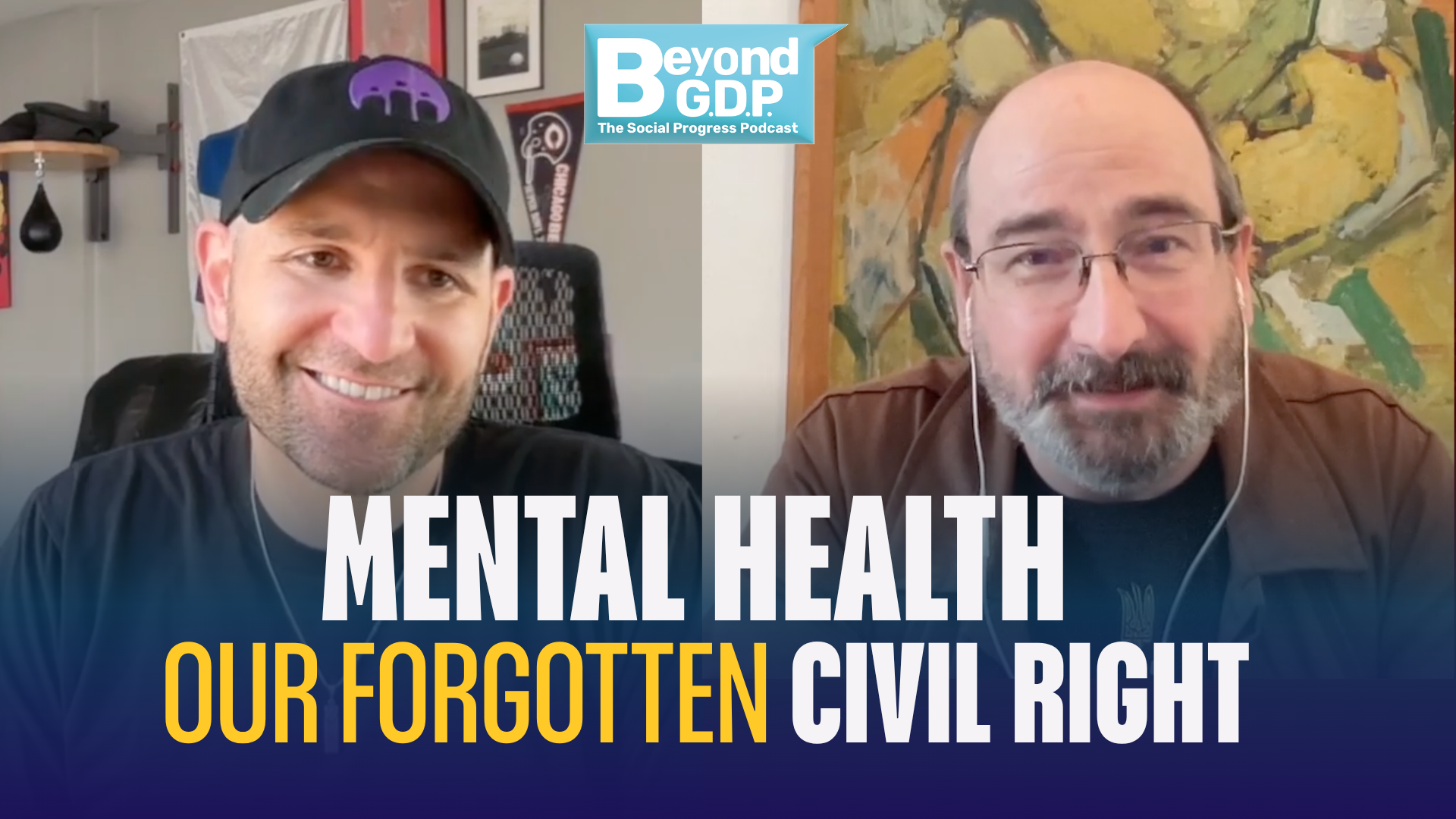
What is the role of businesses in building sustainable communities? To answer this question, we invited Dominic Channer, Vice President for Community Relations at Kinross Gold Corporation, to the Beyond GDP: The Social Progress Podcast. In this episode, Dominic breaks down how the company delivers value to both the business and local communities by shifting the focus of community relations from mere compliance to real long-term engagement. In this episode, you will learn how Kinross approaches community relations across diverse geographies, the importance of early stakeholder engagement, and the evolving role of responsible mining in creating social progress.
From the Sahara Desert in Mauritania to Alaska, the company’s commitment to community engagement is rooted in a clear purpose: generate value through responsible mining. Dominic Channer shares how the company has implemented multiple strategies to work with communities from the early stages of a project through to later stages. Rather than imposing projects, they have teams on the ground whose main job is to incorporate local perspectives directly into their work plans. This is illustrated in their relationships with Indigenous communities. For example, at the Great Bear project in Canada, Kinross has actively incorporated Eastern law and Anishinabe law into its framework. By doing so, the company honors the community’s cultural beliefs, practices, and distinct perspectives on land and water stewardship.
In the conversation, host Michael Green and Dominic also discuss the challenge of greenwashing. Dominic explains that one solution is the slow, deliberate cultivation of genuine relationships. Taking a values-based approach isn't just a moral choice, it is a foundational business strategy. Establishing strong relationships with local communities is fundamental because it provides a foundation for managing impacts and seizing opportunities for mutual benefit. Dominic emphasizes that this improves employee retention, investor confidence, and community support. Trust reduces conflicts, improves operational stability, and enables the company to adapt seamlessly to social and environmental challenges.
The mining sector is evolving, and at Kinross, they’ve recognized the importance of contributing to social outcomes in the communities where they operate. Dominic shares how the Social Progress Index has become an asset not only for identifying gaps but also for informing their strategy. Dominic emphasizes that multi-stakeholder collaboration, bridging the gap between corporates, communities, and governments, is key to achieving scalable and lasting results.
Looking ahead to the coming decades, Michael and Dominic reflect on the future of mining. It’s clear that one of the challenges is transforming the industry so it continues to contribute positively to social and environmental progress.
Ultimately, trust isn’t built overnight. It requires consistent effort, transparent communication, and strong values. As this episode demonstrates, companies that prioritize social impact not only earn community support but also create a sustainable foundation for operational success.
What is the role of businesses in building sustainable communities? To answer this question, we invited Dominic Channer, Vice President for Community Relations at Kinross Gold Corporation, to the Beyond GDP: The Social Progress Podcast. In this episode, Dominic breaks down how the company delivers value to both the business and local communities by shifting the focus of community relations from mere compliance to real long-term engagement. In this episode, you will learn how Kinross approaches community relations across diverse geographies, the importance of early stakeholder engagement, and the evolving role of responsible mining in creating social progress.
From the Sahara Desert in Mauritania to Alaska, the company’s commitment to community engagement is rooted in a clear purpose: generate value through responsible mining. Dominic Channer shares how the company has implemented multiple strategies to work with communities from the early stages of a project through to later stages. Rather than imposing projects, they have teams on the ground whose main job is to incorporate local perspectives directly into their work plans. This is illustrated in their relationships with Indigenous communities. For example, at the Great Bear project in Canada, Kinross has actively incorporated Eastern law and Anishinabe law into its framework. By doing so, the company honors the community’s cultural beliefs, practices, and distinct perspectives on land and water stewardship.
In the conversation, host Michael Green and Dominic also discuss the challenge of greenwashing. Dominic explains that one solution is the slow, deliberate cultivation of genuine relationships. Taking a values-based approach isn't just a moral choice, it is a foundational business strategy. Establishing strong relationships with local communities is fundamental because it provides a foundation for managing impacts and seizing opportunities for mutual benefit. Dominic emphasizes that this improves employee retention, investor confidence, and community support. Trust reduces conflicts, improves operational stability, and enables the company to adapt seamlessly to social and environmental challenges.
The mining sector is evolving, and at Kinross, they’ve recognized the importance of contributing to social outcomes in the communities where they operate. Dominic shares how the Social Progress Index has become an asset not only for identifying gaps but also for informing their strategy. Dominic emphasizes that multi-stakeholder collaboration, bridging the gap between corporates, communities, and governments, is key to achieving scalable and lasting results.
Looking ahead to the coming decades, Michael and Dominic reflect on the future of mining. It’s clear that one of the challenges is transforming the industry so it continues to contribute positively to social and environmental progress.
Ultimately, trust isn’t built overnight. It requires consistent effort, transparent communication, and strong values. As this episode demonstrates, companies that prioritize social impact not only earn community support but also create a sustainable foundation for operational success.
.png)



.jpg)

